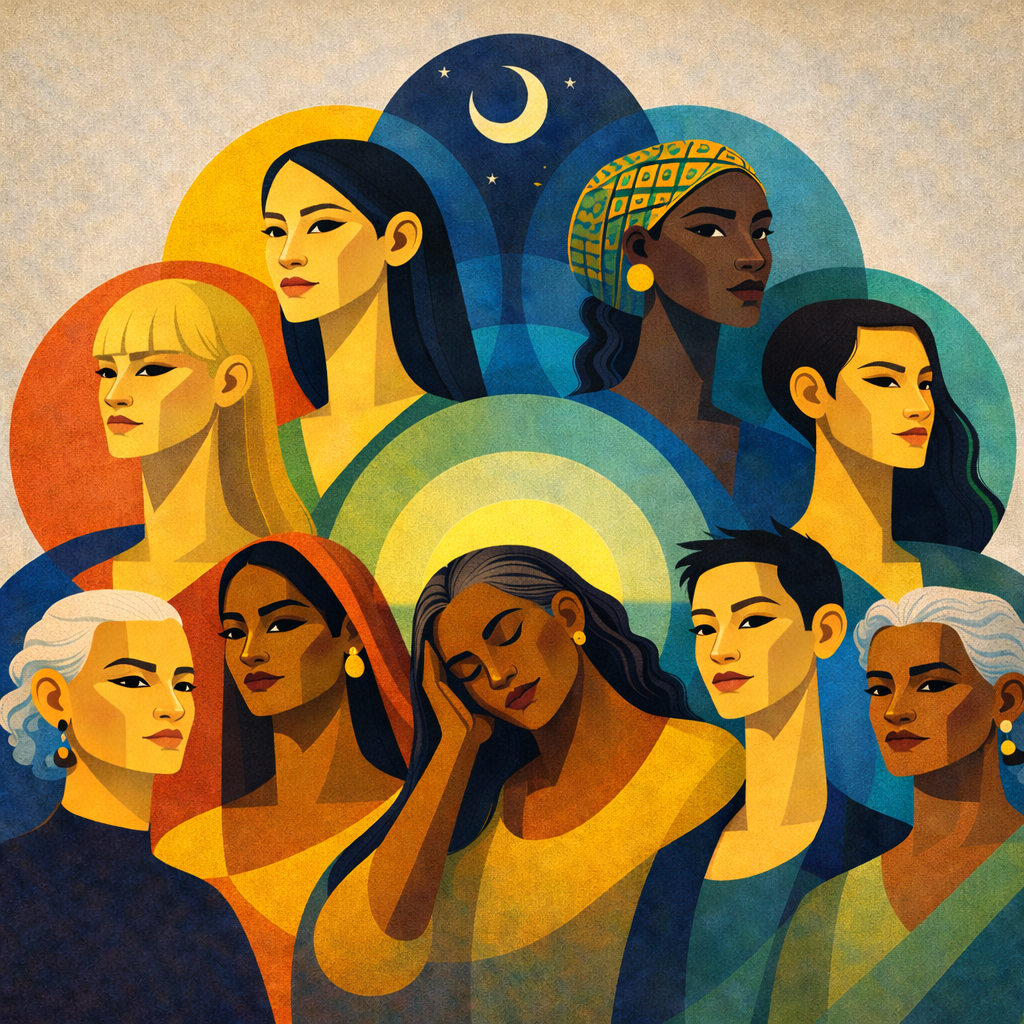
After sixteen years in business, I question the extraction-based logic beneath hustle culture. This essay opens an exploration into whether we can reimagine work around care, reciprocity, and forms of exchange that nourish rather than deplete.
Rethinking Exchange in a World Built on Extraction
February 11, 2026
—
Crystaline Randazzo
Created by Crystaline Randazzo with AI assistance.
In an old Irish myth called The Second Battle of Mag Tuird, the Tuatha Dé Danann (gods of the old ways, tied to nature and magic) battle the Fomorians, chaotic beings of destruction and oppression. Though the Tuatha win, they eventually fade, retreating underground to become the Aes Sidhe, fairy folk and guardians of sacred places.
It seems to me that we are living in a similar time. I may be writing here because I long to hide away in the earth myself, far from chaotic forces of destruction and oppression. And yet, perhaps we have all been underground long enough. Maybe it is this tension that has brought me to the page, to understand what I believe about exchange. Can I do the work I love in a new way, or perhaps an old one?
To be fair, my belief in capitalism has been coming apart for a while now. I’ve been in business since 2009, over sixteen years as a filmmaker, photographer, humanitarian storyteller, science-of-storytelling teacher, story strategist, developmental editor, writer, and brand builder. For most of my career, I held a firm belief in pulling yourself up by the bootstraps. I come from sparkly Marie Forleo can-do optimism, with a dash of Sara Blakely’s belief in failure, and a healthy side of Ira Glass ideology of building toward a body of work that’s up to my taste.
I have faithfully put in my 10,000 hours, probably closer to 60,000 at this point. I have self-helped myself half to death with Deep Work, Purple Cows, and Blue Oceans. And now, I’m no longer convinced they hold the answers to our problems.
Even though I’m an early adopter and certified in AI, I have zero desire to post two times a day. I’m not saying I don’t use the tool, but I do find it largely soulless. I have clients reading me what AI told them, as if it knows their business better than they do. I find the constant churn of content to be a poor substitute for human connection and ideas with depth.
Over the last two years, I’ve found myself in the strange position of caring more about some of my clients’ books or brands than they do. As if, once they write a check, responsibility for care is placed in my hands. It mirrors other areas of life where the burden of care is placed then ignored. It bothers me.
When I care more about their stories than my clients do, the work begins to feel hollow. I’d rather not have the money, which is a strange thing to say out loud. It can feel like prostituting my creativity. If you’re in business, you’ve likely been told that this is simply how it works. We all do things we don’t love in order to do the work we do. And the list of expectations keeps growing: websites, newsletters, social platforms, funnels, automations, AI.
But what if we have this wrong? What if this was never about becoming millionaires? Maybe it was always about keeping a system running, even when it no longer nourishes the people inside it. The way we currently practice capitalism is relatively recent, only a few hundred years old, though it’s often treated as inevitable.
There was a world before capitalism, before patriarchy, before colonialism, racism, or any other ism you want to name. I’m not romanticizing a past without hierarchy or harm. But I am interested in what was lost alongside what was created. And I find myself wondering if the fairy folk have a point. When you are surrounded by systems that exhaust and deplete, perhaps returning to the ways of the earth is not escape, but remembrance.
A few years ago, I was with a friend at a divine feminine retreat in Glastonbury. As we were heading out the door, she picked up a necklace with a large piece of shungite and said, “Oh, this wants to come with us.”
Later, at the top of the Tor overlooking the leylines below, we noticed a woman with two dogs walking in our direction. We invited her to sit with us. She spoke quietly about pet-sitting and seemed heavy with sadness. Then her eyes landed on my friend’s necklace.
“Is that shungite?” she asked. “I think I need something like that.”
Without hesitation, my friend removed the necklace and placed it around the woman’s neck. She protested, but my friend said it was obvious the necklace wanted to go with her.
It was a beautiful necklace. On the way back down, I asked my friend if she’d miss it. She told me she didn’t think like that anymore. Giving to someone else didn’t mean she was losing anything. She said she’d learned this from an Indigenous friend and teacher, through teachings about communal exchange and responsibility.
That conversation has stayed with me.
Most of us are dividing up the pie, trying to get what’s ours, striving to prove that our skills have value. We exchange products, skills, and services for money. That’s business. Bills need to be paid.
But what if that’s not the whole story?
Since that conversation, I’ve read books and articles on exchange, including several connected to my friend’s teacher. I approach this learning carefully, aware that Indigenous knowledge is not something to take or replicate, but something that can point us back to our own ancestral memories of reciprocity. I’ve learned about women’s business exchanges where task-sharing is the process. I’ve wondered if sacred commitments might motivate us beyond money, and if we could trust something as simple as the gift economy.
I write as a feminist and strongly believe systems of feminine exchange and communal care existed before the more patriarchal isms. In Ecofeminism, Maria Mies and Vandana Shiva argue that the enclosure of land and the rise of patriarchal capitalism were inseparable from the control and commodification of women’s bodies and work. Much of what we lost around care, reciprocity, and shared responsibility seems to trace back to that same rupture, which later gave rise to a culture organized around consumption rather than relationship. It doesn’t feel like a coincidence to me.
I enter this exchange with no answers. Just a longing to understand more and to live my life differently. This isn’t a proposal for how everyone should live. It’s an exploration of the questions I carry with me. I don’t know how many pieces I’ll write. I refuse to set a posting schedule. I offer this work freely, and I also offer the opportunity for others to steward it with a paid subscription if they find value in it.
If we live in a culture that has worked hard to eliminate certain ways of knowing, then perhaps our only choice is to follow the breadcrumbs and our intuition backward. To learn from the people and beings who still remember a different way, and to be willing to try things differently. That is what I am here to explore. To re-member.